What Is Essential Learning?

Jamie Bachmann • March 28, 2024

As the 21st Century is starting to gain its footing, things that have been taken for granted just a few years ago are now being questioned and reevaluated.  Throughout the world, pockets of people are doubting whether the Earth is actually spherical, while other groups are examining the necessity for Civil Rights being taught in schools, just as other groups are challenging the necessity for further education.  People everywhere are doubling down on their political and religious values, which is resulting in an increase in home-schooling, but with what quality? 

A young girl is sitting at a desk using a laptop computer.

Outside of formal education, anyone anywhere has the capability of teaching themselves about anything via a device in their pockets.  Is memorization of anything  essential anymore when it can be searched without even the click of a button, but with a voice-activated question to an artificial intelligence?  Information and opinion of literally all types are available 24/7/365.

Additionally, the concepts of jobs and careers are also evolving.  Online influencers of every imaginable concept are earning 6- and even 7-figure salaries.  Writers of every conceivable genre and ability level are self-publishing with varying degrees of success.  People are making better-than-living wages by becoming experts in severely niche interests, from “toys of the 1960s and ‘70s” to “the world’s best hamburgers.”

The world isn’t changing; it’s changed. According to a 2017 article, by Morgan K. Williams, from The Journal of Inquiry and Action in Education  entitled “John Dewey in the 21st Century,” and posted on U.S. Department of Education (.gov), 

Public schools and teachers in the United States are challenged on a daily basis with meeting the diverse needs of all students encompassing differences in gender, ethnicity, socioeconomic background, and various learning styles and needs. Because there is a strong connection between culture and learning, educators should use culturally responsive pedagogy, including high expectations for all students, varied approaches to learning, and fostering community and family engagement (Ford, Stuart, Vakil, 2014).

Given all of the factors, both old and new, how do we as a society direct education for our young people?  Until we can just instantly download information into ourselves, there will need to be some idea of education and standards of education.  Mathematics, Reading, Writing, History, and Science were always given as essential.  Now, we ask Which Math? Is Reading essential in a world of audio books? Is typing perhaps more important than writing?  Are either necessary when we have voice transcription? Whose History do we trust, and why? Which science is necessary to learn when science is forever evolving?

In Peter Gibbon’s article from the Spring, 2019 issue of HUMANITIES: The Magazine of The National Endowment for the Humanities , he wrote of John Dewey,

In 1899, Dewey published the pamphlet that made him famous, The School and Society , and promulgated many key precepts of later education reforms. Dewey insisted that the old model of schooling—students sitting in rows, memorizing and reciting—was antiquated. Students should be active, not passive. They required compelling and relevant projects, not lectures. Students should become problem solvers. Interest, not fear, should be used to motivate them. They should cooperate, not compete. ( ,https://www.neh.gov/article/john-dewey-portrait-progressive-thinker )

The solution, in this writer’s opinion, is exemplified by online one-to-one teaching, as exemplified by private schools like the one I work for, Brightmont Academy ( ,, www.brightmontacademy.com ).  

In the Brightmont system, with the assistance of a single teacher, students follow online programmed courses that are selected based on State and Federal requirements for the student’s ages.  ,, Classes are one hour each and are compelling, with audio options, video illustrations, active exercises, and real-world situations.  As for the content, as I said, it’s determined by State and Federal requirements, but the pedagogy is executed without editorializing and students are allowed to choose how they move through the courses and in what amount of time.  

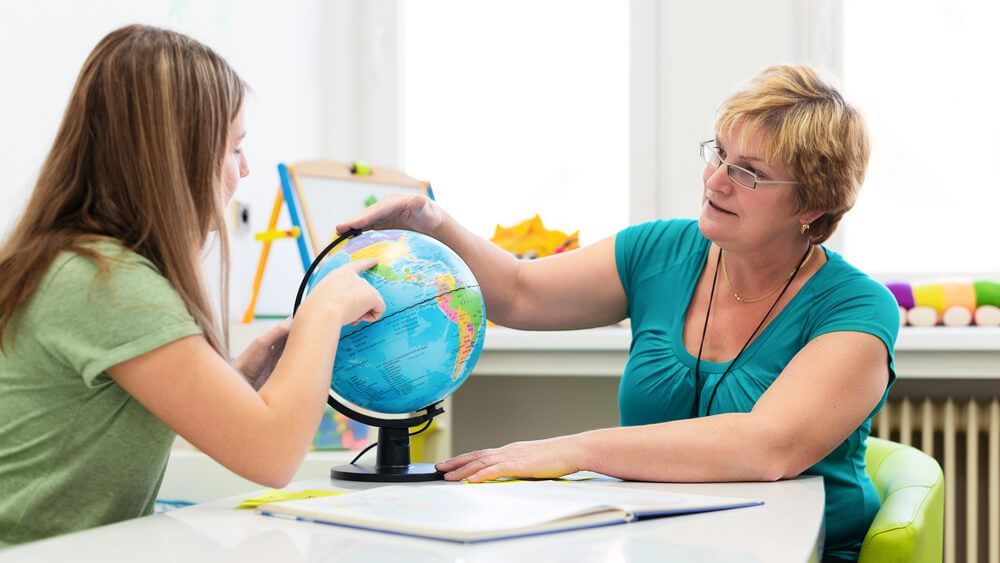
An elderly woman is helping a young girl with her homework.

With a system like ,, Brightmont’s , schools could be limited just to necessary education, and school hours could be drastically reduced.  If a similar school could be placed in each neighborhood (maybe known as “education centers”), students could walk there, thereby eliminating bussing and all its issues, and freeing up even more time for students to pursue personal interests.  Students could wake up later and sleep longer.  Communities could have their own, much smaller school boards, and could establish their own educational requirements and topics to add to them.  A system like this could not only redefine and potentially reinvigorate the practice of education, but it could also be a galvanizing and empowering force for communities.  

Education has always been challenging.  It was back in 1899, when John Dewey wrote The School and Society.  However, as technologically advanced and as educationally and politically polarized as we have become, it seems we still have not met the expectations he outlined, and they seem as “progressive” as they did the day Dewey wrote them.  The future is now, but the educational system is still catching up.

A man wearing glasses and a plaid shirt is smiling in a black and white photo.

Jamie Bachmann is a former high school special education teacher of over 20 years.  He earned his Bachelor’s Degree in Communication Management from The University of Dayton, and his Master of Arts in Teaching from National-Louis University.  He is also a lifelong writer, artist and musician.  Jamie, his wife, and their numerous rescued felines live in Chicago’s North Shore.
More Blog Posts + News


Student with teacher
March 11, 2026
Learn how sleep affects student success and how Brightmont Academy can help with flexible schedules.
Teacher and student
March 5, 2026
Summer learning loss threatens many students’ academic progress. Learn how one-to-one summer learning programs help students sustain momentum year-round.
By Rachel Pollock March 4, 2026
The Top Questions Families in Birmingham ask about Brightmont Academy
March 2, 2026
Brightmont Academy is part of a growing national conversation about how personalized education can better support student success.
Brightmont Academy Expands Chandler Campus to Meet Growing Student Demand
February 27, 2026
Brightmont Academy announces expansion for Chandler campus to continue supporting students in the area.
Brightmont  Academy opens new location in Tempe, AZ
February 26, 2026
Brightmont Academy, specializing in one-to-one instruction for 1st-12th grade students, announces its grand opening in Tempe, AZ.
#NoLimits
February 17, 2026
Illinois Private School Highlights One-to-One Instruction for Grades 1-12 St. Charles & Naperville, IL — Brightmont Academy, an accredited private school offering fully individualized, one-to-one instruction for students in grades 1–12, announces that Meredith Hale, Campus Director of the St. Charles campus, and Lindsay Morales, Campus Director of the Naperville campus, were recently featured guests on the #NoLimits podcast. The podcast is hosted by educator, advocate, and author Shelley Kenow and is rooted in the belief that no one can fully predict a person’s potential or future—and that opportunities should never be limited by labels or assumptions. Hale and Morales connected with Kenow at the Dynamics of Dyslexia conference in Illinois, where they discovered a shared passion for supporting neurodiverse learners and the families who advocate for them. “Meredith and I met Shelley at the conference and quickly connected around our mutual commitment to helping students access education that truly meets their needs,” said Morales. Kenow’s mission to spotlight individuals and organizations that help others reach their fullest potential closely aligns with Brightmont Academy’s educational philosophy. Brightmont partners with families to create individualized learning environments that remove barriers and empower students to thrive academically, socially, and emotionally. “We were honored to be guests on Shelley’s podcast,” Morales said. “Her work centers on helping students and families navigate—and ultimately break through—the limits society often places on them.” For both campus leaders, participating in the podcast reflects their shared commitment to advocacy, connection, and reimagining what education can look like for students who need a more personalized approach. “Being part of Shelley’s community allows us to share how Brightmont supports students in meaningful, individualized ways, and to contribute to a broader conversation about reimagining education for learners who need something different,” Morales added. The #NoLimits podcast is on Apple Podcasts, Spotify, Facebook, and YouTube. Brightmont Academy is located at 620 E Main St. in St. Charles and at 1528 Aurora Ave. in Naperville and is currently accepting enrollments. Families and professionals are invited to attend an Open House event on Thursday, February 19, 2026, between 9:00 AM to 3:00 PM. Brightmont Academy is an accredited private school that provides one-to-one instruction. One experienced teacher works with one student throughout every learning session. Customized full-time programs and individual courses are offered for grades 1-12. Students can also receive individualized tutoring for all 1-12 subjects, study skills, and test prep. Brightmont Academy has served thousands of students since 1999 and has 24 campuses in Arizona, Colorado, Florida, Georgia, Illinois, Michigan, Minnesota, North Carolina, and Washington. For more information call 1-888-521-0887 or visit: www.brightmontacademy.com . Watch our video: Brightmont Academy - The One-to-One Flexible school - 1st through 12th
By Tony Beals February 11, 2026
When we talk about learning differences, vision is often treated as one of the simplest variables to address. The solutions we reach for are familiar in recommending glasses, larger print, or a seat closer to the board. These supports can be helpful, but they are often built on an assumption that vision is primarily about clarity. In my work with neurodivergent and vision-challenged students at Brightmont Academy , I’ve learned that vision is rarely that simple. I’ve worked with learners who have Cortical Visual Impairment (CVI), neurological vision challenges, and progressive vision loss. One student I worked with began losing her sight in 10th grade and is now legally blind. What stood out most was not only how her vision changed, but how quickly expectations around her learning shifted alongside it. The challenge was never her ability. It was her access.  For many learners, vision is not just about what the eyes detect, but how the brain processes, organizes, and sustains visual information. When that distinction is misunderstood, even well-intentioned accommodations can easily miss the mark.
Nadine Ritchotte
February 9, 2026
Private School in Cherry Creek Specializing in One-to-One Instruction for 1st-12th Grade Students Cherry Creek, CO — Brightmont Academy has named Nadine Ritchotte as Campus Director of its Cherry Creek campus, bringing more than 30 years of experience in public education to the role. Ritchotte will lead the new campus as Brightmont continues to expand its individualized, one-to-one learning model for students in grades 1–12 across the Denver metro area. After decades in traditional public education, Ritchotte was drawn to Brightmont’s mission of meeting students where they are academically, socially, and emotionally. After 30 years in public education, I finally realized the limits on what I could change,” Ritchotte said. “Brightmont Academy represents the kind of alternative model I believe in, one that individualizes learning and helps students thrive in a supportive, safe environment.” Located in the heart of the Denver metropolitan area, Cherry Creek is uniquely positioned to serve families across multiple school districts. The area is surrounded by at least five public school systems, each with students who may struggle in traditional classroom environments for a variety of reasons — from learning differences to social challenges or the need for greater flexibility. Ritchotte sees Brightmont’s one-to-one instructional approach as an ideal solution for students who may feel overlooked or unsupported elsewhere. “Brightmont Academy can help those students find their potential and love for learning through one-to-one learning,” she said. Looking ahead, Ritchotte’s vision extends beyond academic progress to help students rebuild confidence and rediscover joy in learning. “I want the Brightmont Academy Cherry Creek Campus to help students rediscover their potential,” Ritchotte said. “Success for our campus looks like a place where students who once struggled feel capable, engaged, and proud to be who they are.” Brightmont Academy is located at 3773 E Cherry Creek North Dr., Suite 145, in Cherry Creek and is currently accepting enrollments. Brightmont Academy is an accredited private school that provides one-to-one instruction. One experienced teacher works with one student throughout every learning session. Customized full-time programs and individual courses are offered for grades 1-12. Students can also receive individualized tutoring for all 1-12 subjects, study skills, and test prep. Brightmont Academy has served thousands of students since 1999 and has 23 campuses in Arizona, Colorado, Florida, Georgia, Illinois, Michigan, Minnesota, North Carolina, and Washington. For more information call 1-888-521-0887 or visit: www.brightmontacademy.com . Watch our video: Brightmont Academy - The One-to-One Flexible school - 1st through 12th
More Posts